Learning the Ropes of D.C.

Shivani Bhogaraju interned with Emily’s List in Summer 2021. She had the opportunity to work with a political action committee (PAC), and gained invaluable experience in the campaign and advocacy sides of D.C.


Before beginning my internship search, I felt quite conflicted. My two years studying political science had sparked my interest in so many different aspects of the political process, and I wasn’t even sure where to begin when applying for prospective positions. Although it was quite difficult to commit myself to applying to as many internships as possible, I pushed through and was incredibly glad I did so. Rejection after rejection rolled in, and by mid-March it felt like I might not have a job for the summer. Luckily, one of my top choices expressed interest in my application, and it was clear to me from the beginning of the interview process that EMILY’s List was a workplace where I could see myself doing meaningful work while learning and growing among like-minded peers. From the beginning, it was important to me to have a job whose core beliefs and values aligned with my own, so I knew from my initial criteria that EMILY’s List would be a good fit for me.

Throughout my internship at EMILY’s List, I had quite a few experiences that expanded my perspective of the campaign process and helped me narrow down my interests in preparation for my upcoming job search. EMILY’s List is a political action committee that helps Democratic pro-choice women run (and win!) positions on the local, state, and federal level. The EMILY’s List team provides a wide variety of resources to candidates, including staff, organizational and financial support, and endorsements. As an intern with the Federal and Gubernatorial Campaigns team, I assisted a wide variety of candidates. With my team of other interns, I quickly learned the ins and outs of running a successful campaign that can withstand many of the complicated and unpredictable roadblocks that candidates face in today’s political landscape. From campaign launches to donor research, every task I was given was one that worked towards electing another woman to office, and regardless of the type of work I was doing it felt amazing to be contributing to the diversification of America’s elected officials.

Although it was definitely disappointing to participate in both my internship and the Illinois in Washington program online, participating in IIW enhanced my internship experience and helped me connect with peers who were also participating in internships both virtually and in person. Throughout the semester, I gained a deeper understanding of both the written and unwritten rules about working in DC. Perhaps the most important ‘unwritten’ rule I learned was the importance of networking, and as a result I had quite a few engaging and helpful networking calls with people who work in fields I am interested in pursuing. The assignments and lessons gave me an opportunity to perfect my argumentative writing and communication skills in a political setting, and I emerged from the program with a better sense of how to develop and articulate an argument that will resonate with others. Participating in IIW made my virtual internship feel a little bit less isolating, and I am so grateful for both the relationships and skills I’ve gained throughout the summer.
Fostering Independence with FedSec

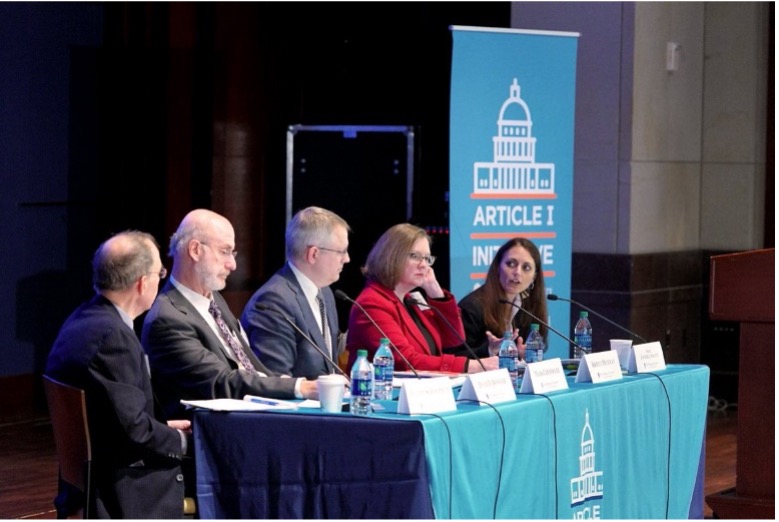
Benjamin Nathan interned remotely with the Federalist Society in Summer 2021. While the virtual mode of the internship meant Benjamin has less interaction with supervisors and co-workers, he had the opportunity to develop independence in this work habits.


My summer as a remote intern for the Federalist Society (FedSoc) has been an interesting one. While this IIW experience was far from a normal one given COVID-19 and its associated difficulties, FedSoc had no shortage of engaging work to assign to me. Before getting into all of that, let’s take a brief look at what the Federalist Society actually is. Generally speaking, there are three primary sections of FedSoc: practice groups, lawyer groups and student groups. Where all three types of FedSoc group organize lectures, panels, and other events that relate to a given topic, practice groups exclusively plan events relating to that group’s theme, which could be anything from civil rights to antitrust. Where the student groups will largely be organizing speaking events, practice groups have a wider variety of offerings, often starting podcasts and creating animated videos relating to a topic that they deal with. Notably, the student chapters can be found at most reputable law schools. Even the University of Illinois at Urbana-Champaign has a Federalist Society chapter.

Going back to what I’ve been doing this summer, for the majority of the internship, I have been working on the Comparative Policy Project, which aims to see how Federalist Society speakers’ views have changed over the years. In practice, that meant I would spend the summer reading, categorizing, and summarizing as many Federalist Society publications as I could. Whether it was a three-minute informational video about the implications of a Supreme Court case, or a 90-minute recording of a panel of speakers discussing international criminal justice issues, I was expected to summarize it in full, capturing the essence of whatever the speaker was trying to communicate. That work has undeniably bolstered my ability to summarize and comprehend any piece of written work I come across. Whether it’s a news article, scholarly paper, or something else entirely, getting a sense of both what the author is trying to say, and where in their publication they are communicating the substance of what they’re trying to say is essentially automatic at this point.

Interestingly, FedSoc has taken a hands-off approach with internship supervision as a result of the remote nature of the position. Therein lies the greatest drawback of COVID-19. Despite my job not actually needing any sort of supervision, if I were in the office, I would undoubtably have more interactions with my coworkers. When your job does not directly require you to be in communication with anyone, forging professional relationships over zoom becomes quite difficult. Despite the lack of professional interaction, this experience has doubled as an opportunity to truly become self-sufficient. As a FedSoc intern, I honor every facet of my work as was initially agreed – from clock-in and clock-out times to the substance of the work itself. I do as much, and often even more than was asked of me despite there being no enforcement mechanism whatsoever. That is quite different from my previous professional experiences since I’ve almost always had a supervisor trying to micromanage my work. Resultingly, the shift from overbearing supervision to complete independence was initially jarring. However, at this point in the internship, having worked through it and found new sources of motivation, I can comfortably say that I will be reaping the benefits of this position for years to come. When my time as a Federalist Society intern is over, I will leave the organization with a newfound sense of independence and an undeniably improved professional demeanor.

Illinois in Washington
University of Illinois at Urbana-Champaign
420 David Kinley Hall
MC-713 | 1407 W. Gregory Dr.
Urbana, IL 61801

217-333-3881